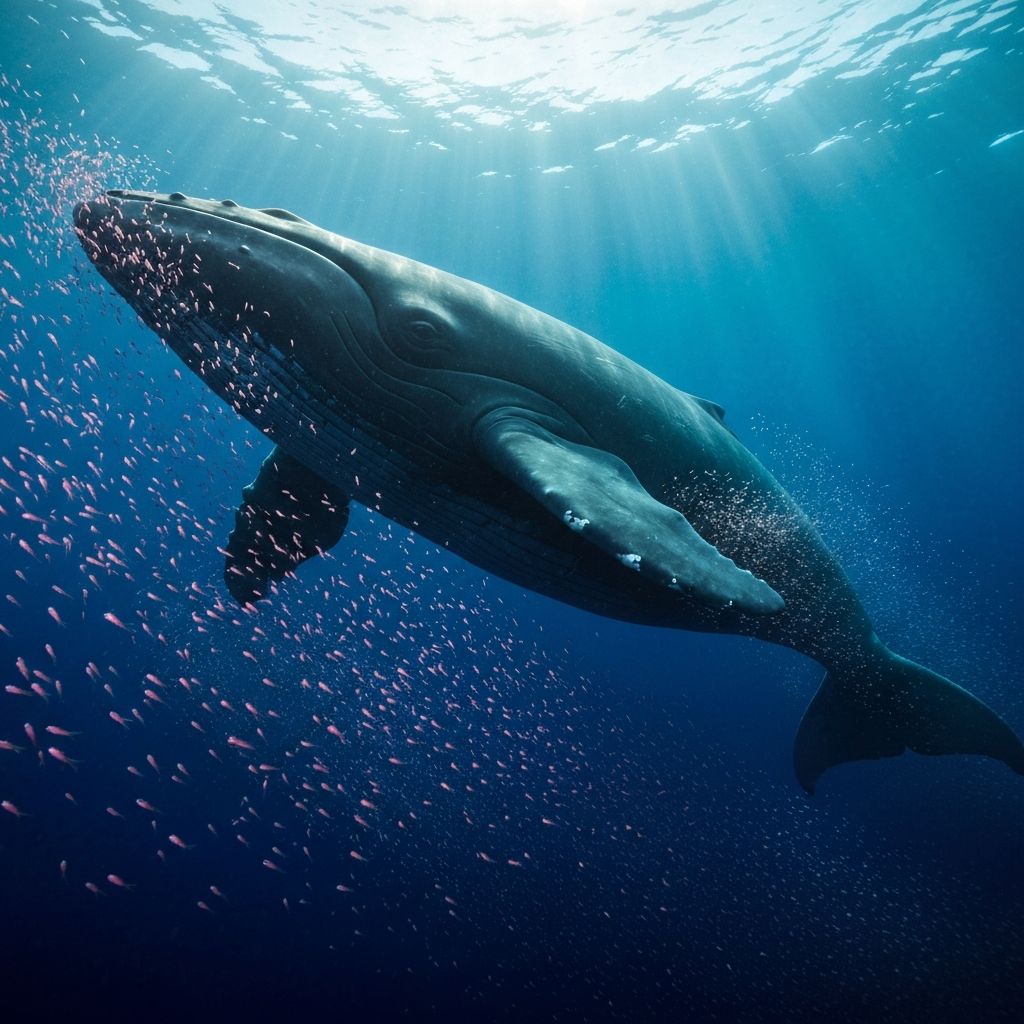
Every year, the Antarctic krill fishery harvests hundreds of thousands of tonnes of these tiny crustaceans to fuel a booming supplement industry. What most consumers don't realize is that their omega-3 capsules are directly competing with some of Earth's most magnificent creatures for survival.
The Foundation of Antarctic Life
Antarctic krill (Euphausia superba) may be small—typically just 2 inches long—but they are the keystone species of the entire Southern Ocean ecosystem. These tiny shrimp-like creatures form massive swarms that can stretch for miles, creating the primary food source for an astonishing array of marine life.
According to the Marine Stewardship Council, krill serves as the fundamental food source for whales, seals, penguins, seabirds, and countless fish species. Without abundant krill populations, the entire Antarctic food web collapses.
The Numbers That Matter
- 16 tons— The amount of krill a single blue whale can consume per day during feeding season
- 4%— Percentage of body weight large baleen whales consume daily during their 4-6 month intensive feeding season
- 400,000+— Tonnes of krill harvested annually by commercial fishing operations
The Growing Conflict
A 2024 study published in Nature Communications highlighted the growing conflict between industrial krill production and the protection of the Antarctic ecosystem. The research emphasized that as the market for krill products—particularly krill oil supplements—expands, the pressure on krill populations intensifies.
The timing couldn't be worse. Whale populations are still recovering from decades of commercial whaling, and they're returning to feeding grounds only to find increasing competition from industrial fishing vessels. The Pew Bertarelli Ocean Legacy project reported in 2025 that new studies bolster the case for predator-focused management of the Antarctic krill fishery, emphasizing that current practices don't adequately protect recovering whale populations.
"The Commission for the Conservation of Antarctic Marine Living Resources (CCAMLR) was unable to renew spatial catch limits in 2024, highlighting the urgent need for improved management of the krill fishery."
Why Humans Don't Need Krill Oil
The primary selling point of krill oil supplements is their omega-3 fatty acid content—specifically EPA (eicosapentaenoic acid) and DHA (docosahexaenoic acid). These essential fatty acids support heart health, brain function, and reduce inflammation. However, here's what the supplement industry doesn't want you to know: you can get these exact nutrients from sources that don't devastate marine ecosystems.
Sustainable Omega-3 Alternatives
Algae-Based Omega-3 Supplements
This is the most direct alternative. Algae oil provides EPA and DHA in forms identical to fish or krill oil. In fact, fish get their omega-3s from eating algae in the first place—so you're simply cutting out the middleman. Research published by the University of Southampton confirms that algal oils serve as a sustainable, direct source of EPA and DHA.
Flaxseed and Chia Seeds
These plant sources are rich in ALA (alpha-linolenic acid), which your body can convert to EPA and DHA. While the conversion rate is limited, regular consumption combined with algae supplements provides complete omega-3 coverage.
Walnuts and Hemp Seeds
Excellent dietary sources of ALA that can be easily incorporated into daily meals. A handful of walnuts provides your daily ALA requirement.
Ahiflower Oil
A newer plant-based option containing stearidonic acid (SDA), which converts to EPA more efficiently than ALA. Research is ongoing, but early results are promising.
According to the National Institutes of Health Office of Dietary Supplements, while the body converts ALA to EPA and DHA in small amounts, supplementation with algae-based products has been shown to significantly improve plasma DHA concentrations and omega-3 indices—matching or exceeding the benefits of marine-sourced supplements.
The Real Cost of Your Supplement
When you purchase a bottle of krill oil, you're not just buying omega-3s. You're contributing to an industry that:
- Depletes the primary food source for endangered whale species still recovering from commercial whaling
- Competes directly with penguins, seals, and seabirds for their main food source
- Operates in one of Earth's last pristine wilderness areas
- Lacks adequate management frameworks to protect ecosystem health
The Frontiers in Marine Science journal published research in 2024 calling for urgent revision of the management framework for the Antarctic krill fishery to account for the needs of recovering whale populations. The current system, they argue, fails to protect the predators that depend on krill for survival.
What You Can Do
1. Switch to algae-based omega-3 supplements. They're widely available, competitively priced, and provide the same health benefits without the ecological devastation.
2. Spread awareness. Many people simply don't know about the impact of krill harvesting. Share this article with friends and family who use krill oil supplements.
3. Support marine conservation organizations working to establish better protections for Antarctic waters and the species that depend on them.
4. Contact supplement companies. Ask them about their sourcing practices and encourage them to offer algae-based alternatives.
The Bottom Line
The choice is simple: we can get our omega-3s from sustainable plant and algae sources, or we can continue depleting the food supply that whales, penguins, and countless other species need to survive. Blue whales need 16 tons of krill per day. You need about 250mg of EPA and DHA. The math doesn't add up—and it never will.
Every time you choose an algae-based supplement over krill oil, you're voting with your wallet for a future where these magnificent creatures have enough to eat. It's a small change that makes a world of difference.
Sources & Further Reading
- •Nature Communications: "Antarctic krill fishery ecosystem impacts and whale recovery" (2024)
- •Pew Bertarelli Ocean Legacy: "Predator-focused management of Antarctic krill fishery" (2025)
- •Marine Stewardship Council: Antarctic Krill Species Profile
- •Smithsonian Ocean: "The Tons Whales Eat—and Poop"
- •NIH Office of Dietary Supplements: Omega-3 Fatty Acids Fact Sheet
- •Frontiers in Marine Science: "Ecosystem approach to Antarctic krill fishery management" (2024)
- •CCAMLR: Krill Fisheries and Sustainability Reports
Endangered Earth Team
Dedicated to uncovering environmental threats and empowering individuals to make informed choices that protect our planet's fragile ecosystems.